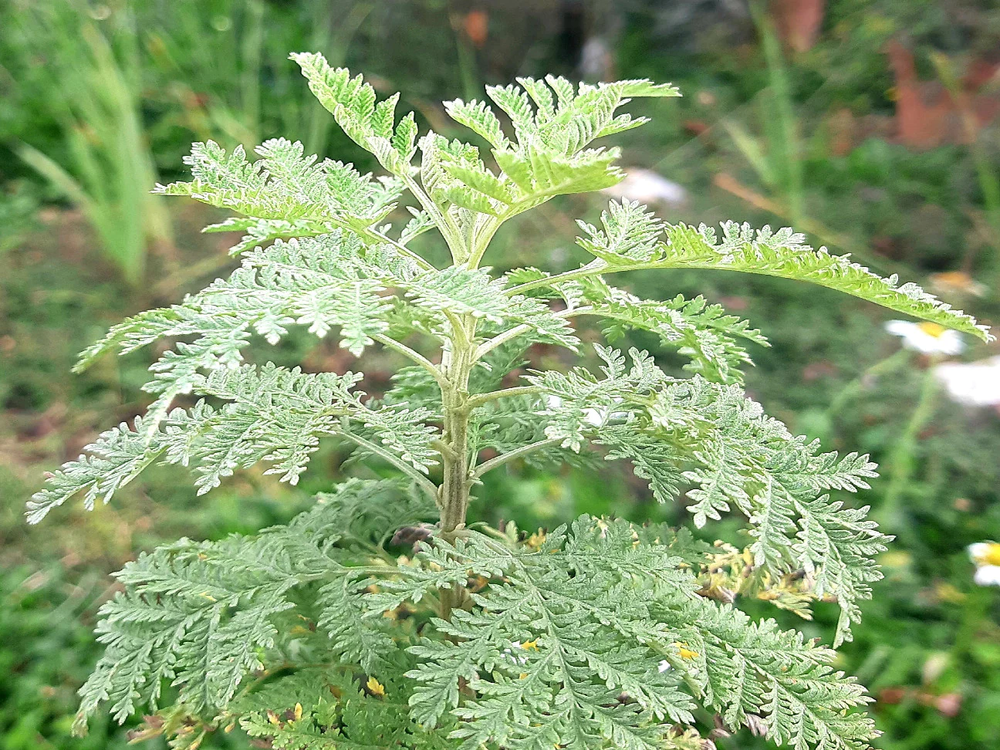
In March 2022, a small group of herbalism students engaged in an eight week exploration of the indigenous African herb, Artemesia Afra.
Each day, we would each sit with this plant, opening to pathways of communication through our senses and intuition: we recalled our dreams each night, took note of emerging patterns in our psyche and behaviour, and observed the effect on our physiology in response to drinking the tea twice daily. The information shared here is based on both our personal experience and the teachings of a Sangoma elder.
Umhlonyane, the Zulu name for this herb means courage, while artemesia afra is named for the Greek goddess of the hunt, Artemis. Mythology tells us that Artemis was brave, strong, ruthless, resilient, capable, resourceful, active, alert, clear sighted and focused. Her arrow always found its mark, yet she was compassionate and tender, particularly towards the vulnerable and innocent, children and the creatures of the forest. Her feminine nature arises in good measure – a goddess of the Moon.
In our group, we each witnessed these traits coming to the fore, as our beings absorbed the energy of this plant.
Some of us sensed a lionhearted courage arising as we found our voice and spoke our truth with clarity and precision, finding we were able to handle challenging interactions with a tangible inner strength and calm.
Some found they were better able to rise to the challenge of work pressures, whilst remaining rhythmic and grounded as they navigated the load.
One person noticed that clarity arose around problems which previously had been confusing for her.
Another found that she could more easily bring projects to fruition, which added to her confidence in being able to make things happen.
I observed that I was more easily moving past the distractions of others around me. I let go of the need to please and the need for recognition. Rather, I felt directed by my own inner upward and outward surge of life force energy. I felt self contained in higher vision, yet brushing softly with those around me as I maintained an openness of heart.
The Zulu and Latin names of this plant do indeed seem to hold appropriate meaning.
So too does the morphology speak of its unique essence; growing tall, bountiful and upright, often from hard, dry soils, it seems to surge with a dynamic inner force towards the light. And although tall and robust, it dances with flexibility and ease in the strong winds. Soft new leaf buds emerge from seemingly dead wood, grabbing opportunity for new growth from hard circumstance, generating arrow shaped leaves with feathery fronds, offering a sense of gentleness within focused form. At full moon, these silvery leaves perk up a little, as if in praise of the light of the moon. Flowers appear from little balls, looking rather like a crown at the apex of each branch, and then each one humbly makes a little bow. It does seem that the morphological signature of this herb also brings a sense of an embodiment of a certain balance of the masculine and feminine energies of the cosmos.
There is certainly some Mars influence, a strongly masculine planet of dynamism, power, heat and activation, related to the elements of fire and ether. But it is tempered with feminine cosmic bodies: the harmony and grounding of Venus, air and earth, and the quelling of the Martian fire by the watery moon, deepening intuition. Perhaps there is a touch of airy Mercury – a planet which embodies both masculine and feminine, and which combines reason and communication. I have a little hunch of Jupiter influence too – expansion into higher vision and goals, (ether). These are simply suggestions; not set in stone.
In looking at the physiological effects of wilde als, we can draw reference to the elements related to the above mentioned planets. On drinking a cup of the tea, each member of our group noticed that we would immediately grow hot, some of us breaking out in perspiration. In addition, our digestive systems seemed to be stimulated, often resulting in easy bowel movement. We also sensed an expansion of energy in the head and crown. After a couple of weeks of drinking two cups a day, we all noticed a dryness in our tissues.
Through our own bodily experience, we concluded that wilde als is mostly warming, cleansing and stimulating (fire) and drying (air). Hence, if you have a body constitution that is already dry and warm, and yet you feel called to drinking wilde als in some form, it is advisable to balance with cooling, moistening herbs.
Peter von Maltitz, otherwise known as Zanemvula of the Xhosa sangoma tradition, added his threads of wisdom to our growing web of knowledge. He taught us that parasites and cancer cells gorge themselves on iron in the body. When wilde als is ingested, it forms a black oxide of the iron inside these cells, turning it into a rock. As a result, the parasite cells die off and the growth of cancer cells is inhibited, indeed they too are likely to eventually die. Interestingly, iron is the metal of Mars.
Zanemvula also shared that after a week of drinking the tea, worms in the large intestine are killed, and this part of the gut is cleared of stinky air and slime. Consequently, the lungs, (the corresponding organ to the large intestine in Chinese medicine) are cleared of mucous. It is partly this that makes wilde als such an effective respiratory cleanser, as well as a powerful antibiotic and antiseptic. It is useful for asthma and also clears the excess mucous associated with colds, coughs and influenza. The lungs and large intestine relate to the air element.
Zanemvula continued to teach that umhlonyane activates and strengthens the liver to metabolise and coagulate toxins in the body, so that the kidneys can more easily filter them out. The liver is related to the ether element; a strong liver functions as an effective ‘commander and general’ on the battlefield of life, planning and executing with confidence and courage. However, it is also important to note that this herb includes the compound thujone, which in overdose, can become toxic for the liver. Thus, ingestion of umhlonyane is recommended for no more than 4 -10 days at a time. Indeed, those of us in our group who drank the tea for over a month began to experience minor symptoms of nausea, headache and shakiness.
Surprisingly, but perhaps as a balance to its dynamic medicinal properties, Zanemvula advises that the herb is also effective as an African version of chamomile: rubbing it on babies’ gums facilitates easy teething, while drinking as a tea brings a sense of calm and grounding which supports effective decision making.
A final point this wise sangoma shared with us is that wilde als teaches our bodies to break down double sugars into more digestible single sugars, supporting resistance to candida and thrush, which of course, thrive on sugars and carbohydrates in the diet.
There are many more ailments that wilde als is known to alleviate: appetite loss, arthritis, bruising, bladder and kidney dysfunction, colic, digestive problems, diabetes, earache, eye infection, fever, gout, headache, haemorrhoids, malaria, menstrual and post birthing pain, sweaty feet, and of course, for keeping the pests away in the vegetable garden….. wilde ‘alles’!
This herb can be applied in various ways. Here are a few of my favourites: externally as nose and ear plugs, as an ointment, poultice, massage oil, essential oil and as a wash for bathing; smoke smudging and steaming; and internally as a tea, tincture or infused oil. And remember to scatter leaves between your rows of veggies.
To sum up, I am in awe that we have this incredible plant growing naturally in our African soil. To my mind, it has a significant role to play in assisting us through these tumultuous times, not only as a remedy for the strong respiratory infections that are occurring across the globe, but also as an ally to support us in both courage and dignity as we stand in our truth and sovereignty amidst the push and pull of old world systems and the attempts by powerful entities to maintain and tighten control.
Thank you, Creator and Creation for the blessing of Umhlonyane!
References
- Jane’s Delicious Herbs — Jane Griffiths
- Medicinal Plants of South Africa — Ben van Wyk, Bosche van Oudtshoorn & Nigel Gericke
- South African Medicinal Plants — Das Lyon
Acknowledgements
- To Avice Hindmarch, Gary Kritzinger and Vanessa Brewer, whose insights during our group exploration of artemesia afra, inspired me to write this article.
- And to Peter von Maltitz for generously sharing his knowledge.